
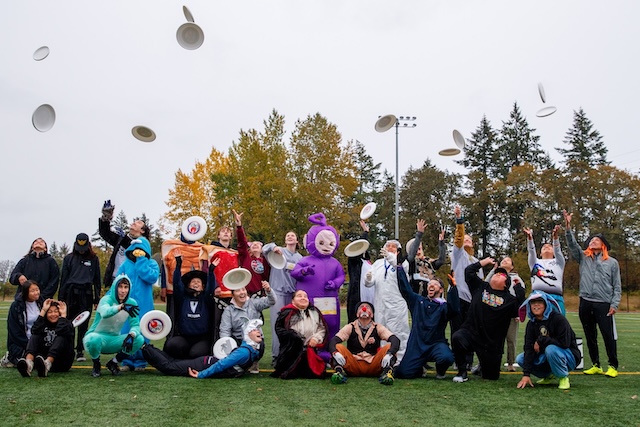
When people think about inclusive activities for people of different ages, abilities, and backgrounds, ultimate frisbee is likely not the first to come to mind. However, Jimmy Roney, Community Ultimate Spirit Program developer and founder of Ultimate Spirit, believes deeply that ultimate is the perfect vehicle to bring Indigenous and non-Indigenous communities together through a collective respect — for not only the game— but for each other.
Ultimate Spirit was founded in 2017 as an Indigenous-focused program delivered by the BC Ultimate Society. It is a collaborative initiative that takes a holistic approach to health, acknowledging the importance and interaction of the physical, mental, spiritual, and cultural aspects of Indigenous communities in BC.
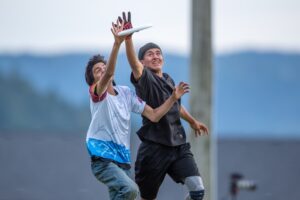 What makes the game of ultimate different from other sports is that it is self-refereed. With this unique quirk, the spirit of the game shines brightest when opposing teams must come together to make decisions that have an impact on the game’s outcome. Through this exchange of opinions to find a consensus, a community is built.
Throughout his time developing the program, Roney has made Ultimate Spirit an inclusive space to ensure that everyone feels like they belong in the ultimate community. “It’s up to the players to have personal agency, to have autonomy in the decision-making. You end up getting this incredible environment where perspectives have to be shared … I like to believe that it creates an inclusive environment or a place of belonging because everyone’s voice is honoured.”
Ultimate Spirit has made an impact on multiple communities throughout the province, including at the Xet̓ólacw Community School and W̱SÁNEĆ Leadership Secondary School. Mark Gabriel, a mathematics and physical education teacher, formed the ultimate frisbee team at Xet̓ólacw Community School, which now works with Roney and Ultimate Spirit. Gabriel noted how the Xet̓ólacw Community School is a close group, and it is not surprising that their athletes give back after graduation.
“Even after the students graduate, they’re still heavily involved with doing these activities and growing a little bit more as leaders … Some are still involved [with] Ultimate Spirit when they go coaching somewhere else.”
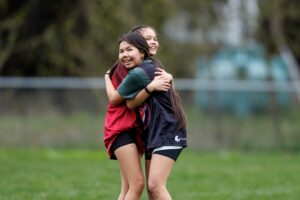 Trust is a major component in the work that Ultimate Spirit does with Indigenous communities, as Roney described a foundational piece of the program as “moving at the speed of trust.” Even something as simple as a translation of the rules will strengthen bonds throughout a community.
“Because we play internationally, oftentimes your competitor doesn’t speak the same language as you. After four years of building trust within W̱SÁNEĆ, the elders understand when they look at the youth, the impact that’s happening, [and] they’ve translated the World Flying Disc Association hand signals into their traditional language. Now we’re at the point where our youth coaches are sharing how to say their traditional language for that sign.”
With Roney’s strong ties to the ultimate community across British Columbia, the next step was bringing the next generation of ultimate athletes together. The University of Victoria was a perfect match for the two programs to bond over flying discs – with their strong ultimate frisbee program, and their proximity to W̱SÁNEĆ Leadership Secondary School.
“University of Victoria and UBC used to have a tournament called the Douglas Bowl … I was able to bring about 12 W̱SÁNEĆ participants to observe and watch the game just so they could see what a high level of ultimate looks like. And then after the game, the UBC and UVIC athletes were invited to participate in a huge capture the flag ultimate style game.
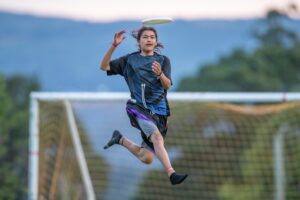 On that day, a new relationship was forged between the W̱SÁNEĆ Leadership Secondary School and the University of Victoria ultimate team. What started as a viewing of top-level ultimate in 2019 has led to an annual Halloween event between the two programs where every participant runs around in costumes while playing the game they love. However, these bonds between athletes aren’t the only changes that have been made through ultimate.
“I keep telling the kids that this was your contribution; they now call it [the] Dogwood Bowl. It’s one of those really cool situations where these interactions have a ripple effect, and that in itself is an example of social change.”
About the Author
 Ethan Paulson loves going for a swim, even in the middle of winter! Growing up in the Lower Mainland of British Columbia, he was surrounded by beautiful lakes and rivers, which he spent countless hours in during the summer. When Ethan isn’t taking a plunge, he is a 4th year Communications student at the University of the Fraser Valley, writer for his schools’ newspaper and a former Communications Assistant Intern for BCRPA. With a passion for sport and recreation, Ethan hopes to bring communities together through a shared love of the game.